
FULL HTML
FRONTIERS IN MEDICAL CASE REPORTS - Volume 7; Issue 5, (Sep-Oct, 2026)
Pages: 01-08
Print Article Download XML Download PDF
ExoTMS® in a Patient with Endometrial Cancer and Major Depressive Disorder: A Case Report
Sanjay Thunga, Shaurya Mahajan, Arya Bhakta, Laalasa Vinnakota, Mia Arnautalic, Yatharth Mahajan, Netra Ramanathan, Vipul Reddy, Charles Vigilia, Keerthy Sunder
Category:Medical Case Reports
Abstract:
Major depressive disorder (MDD) frequently co-occurs with complicated grief and psychological distress related to cancer survivorship, and a substantial proportion of patients do not achieve remission with conventional treatment. This case report describes a 59-year-old woman with MDD, complicated grief following a significant personal loss, and a history of endometrial cancer in remission, who underwent 10 sessions of ExoTMS, a novel repetitive transcranial magnetic stimulation (rTMS) platform, targeting the left dorsolateral prefrontal cortex. Outcomes were assessed using the Perceived Stress Scale (PSS-10), Brain Fog Scale, Insomnia Severity Index (ISI), and Warwick-Edinburgh Mental Well-being Scale (WEMWBS). Following treatment, the patient demonstrated an 18.8% reduction in perceived stress, an 18.6% reduction in brain fog, a 73.7% reduction in insomnia severity (shifting from moderate clinical insomnia to no clinically significant insomnia), and a 14.9% improvement in mental well-being. Treatment was well tolerated, with no adverse effects reported across all sessions. These findings provide preliminary, hypothesis-generating observations and support further investigation of ExoTMS in larger, controlled studies.
Keywords: ExoTMS, Repetitive Transcranial Magnetic Stimulation (rTMS), Major Depressive Disorder (MDD), Complicated Grief, Endometrial Cancer Survivorship, Insomnia
Full Text:
Introduction
Major depressive disorder (MDD) is a common psychiatric disorder characterized by persistent depressed mood, loss of interest or pleasure, and cognitive and vegetative symptoms that can significantly impair daily functioning. Despite established treatments, including pharmacotherapy and psychotherapy, approximately 30% of patients with MDD do not achieve remission despite multiple treatment attempts (Otte et al., 2016). Depression and psychological distress are also important concerns among cancer survivors. In long-term survivors of endometrial cancer, there was a higher prevalence of self-reported anxiety and depression compared with population norms (Sanjida et al., 2021). These findings highlight the potential for persistent psychological burden among endometrial cancer survivors, which may be further complicated by psychosocial stressors such as bereavement and grief.
Grief is a natural response to the loss of a loved one and typically decreases in intensity over time; however, some bereaved individuals experience persistent grief that causes significant distress and functional impairment, a condition now commonly referred to as prolonged grief disorder (PGD) (Szuhany et al., 2021). Although PGD and MDD share symptoms such as sadness, social withdrawal, sleep disturbances, and guilt, they are considered distinct conditions. Whereas symptoms of MDD tend to be more generalized, PGD is specifically associated with loss and may involve persistent yearning or preoccupation with the deceased (Eisma, 2023). Nevertheless, the conditions frequently co-occur. In a nationwide study of bereaved family members of cancer patients, 58% of participants with possible complicated grief exhibited comorbid symptoms (Aoyama et al., 2018).
Given the burden of MDD and the potential complexity of co-occurring grief-related symptoms, effective treatment strategies are important for patients who do not adequately respond to conventional interventions. Repetitive transcranial magnetic stimulation (rTMS) is a noninvasive neuromodulation technique that uses magnetic pulses to induce electrical currents in the cerebral cortex and modulate neural activity (Noda et al., 2015). The dorsolateral prefrontal cortex (DLPFC) is a primary target of rTMS for depression, although the mechanisms underlying its antidepressant effects are not fully understood (Noda et al., 2015). In a systematic review and network meta-analysis of 69 randomized controlled trials involving 10,285 participants, rTMS was found to be associated with significantly greater treatment response and remission compared with placebo or sham treatment (Saelens et al., 2025).
ExoTMS is a newer rTMS platform that incorporates features including a double-core stimulation coil, active cooling, ramp-up stimulation, and navigation-guided coil positioning (Pánek et al., 2026). Published evidence regarding ExoTMS remains limited, and existing studies have examined heterogeneous clinical and subclinical populations (Pánek et al., 2026; Dees, 2026). Further research is therefore needed to evaluate its clinical effects in specific psychiatric populations.
This case report describes the use of ExoTMS in a patient with MDD, a history of endometrial cancer in remission, and complicated grief, with a focus on changes in clinical symptoms and mental well-being following treatment.
Case History
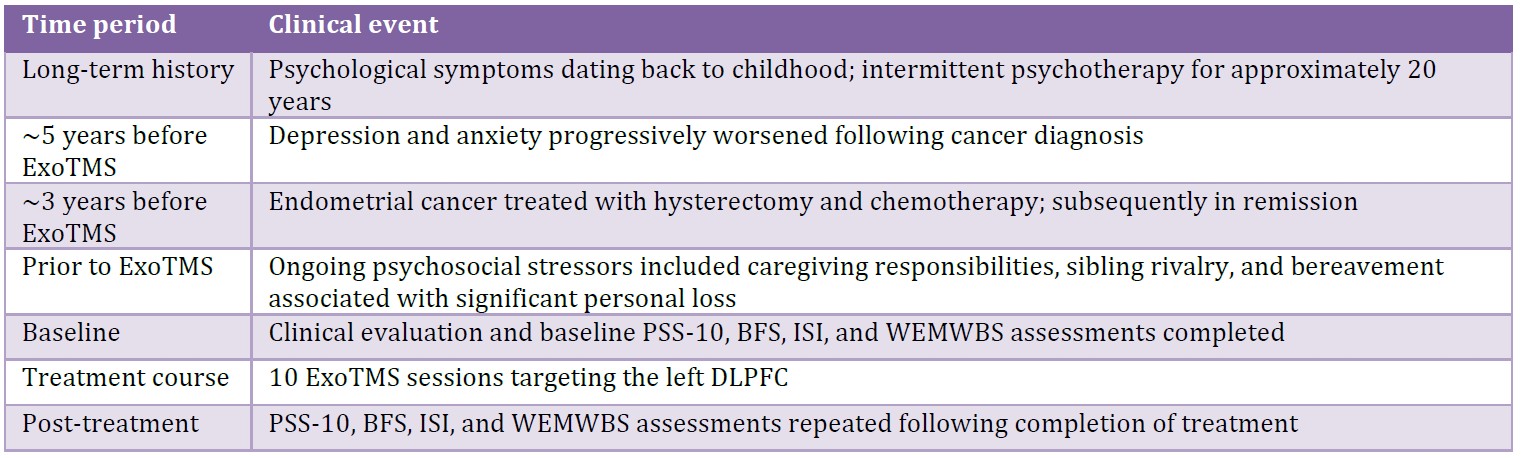
A 59-year-old woman with a history of endometrial cancer in remission presented with depression, anxiety, and symptoms of complicated grief associated with a significant personal loss. She reported that her depressive and anxiety symptoms had progressively worsened over the preceding five years following her cancer diagnosis, with a longer history of psychological symptoms dating back to childhood in the setting of adverse childhood experiences. She had participated intermittently in psychotherapy for approximately 20 years and reported significant ongoing stress related to caregiving responsibilities, sibling rivalry, and bereavement.
Her medical history was notable for endometrial cancer treated with hysterectomy and chemotherapy approximately three years prior to evaluation, as well as a remote head injury at age 19. She denied past suicide attempts, suicidal or homicidal ideation, and psychotic symptoms. Her only reported medication was valacyclovir, taken as needed.
On mental status examination, the patient was appropriately groomed, alert, and fully oriented. She demonstrated distant and withdrawn behavior, variable eye contact, slow speech, neutral mood, and flat affect. Her thought processes were coherent, logical, and goal-directed, with intact concentration and memory and good judgment and insight. Following evaluation, treatment options were discussed, including TMS, and the patient elected to pursue ExoTMS treatment. A timeline of the patient's clinical history, treatment, and assessments is provided in Table 1.
Table 1: Timeline of Clinical History, Treatment, and Assessments.
Methods
ExoTMS Protocol
The patient underwent 10 ExoTMS treatment sessions targeting the left dorsolateral prefrontal cortex (DLPFC), administered by certified neurotechnologists under clinical supervision. The patient was positioned in a semi-reclined position, and the left DLPFC was localized using the standard scalp-based 5-cm method, with the treatment site identified 5 cm anterior to the motor hotspot used for motor threshold determination. Motor threshold (MT) was individually determined prior to treatment as the lowest stimulation intensity capable of eliciting a contralateral motor response and was measured at 75% of maximum stimulator output.
Stimulation was delivered at 12–18 Hz using 2-second trains separated by 5-second inter-train intervals, consistent with previously reported ExoTMS protocols (Pánek et al., 2026). Treatment intensity was individualized relative to the patient's MT and gradually titrated based on tolerability until reaching 100% of MT, after which intensity was capped for the remainder of treatment. Each session lasted approximately 25 minutes.
The patient was monitored throughout treatment for adverse effects, including scalp discomfort, headache, and seizure-related events.
Outcome Measures
Clinical outcomes were assessed using the 10-item Perceived Stress Scale (PSS-10; a measure of perceived stress), Brain Fog Scale (BFS; a measure of self-reported cognitive symptoms), Insomnia Severity Index (ISI; a measure of insomnia severity), and Warwick-Edinburgh Mental Well-being Scale (WEMWBS; a measure of mental well-being). All four measures were administered at baseline, prior to treatment initiation, and again following completion of the 10-session treatment course. Expected outcomes included reductions in perceived stress, brain fog, and insomnia, as well as improvement in mental well-being.
Results
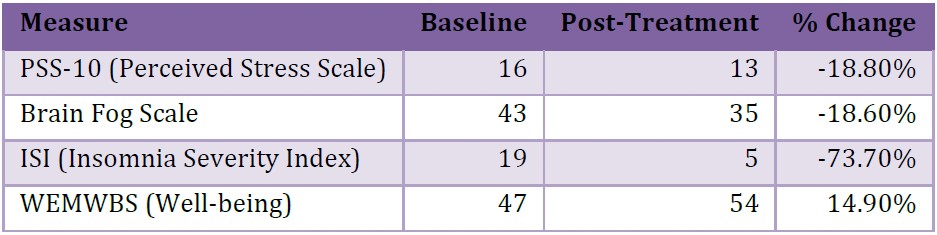
The patient completed all 10 ExoTMS treatment sessions without reported adverse effects. Following treatment, improvements were observed across measures of perceived stress, brain fog, and insomnia (Table 2). The Perceived Stress Scale (PSS-10) score decreased from 16 at baseline to 13 following treatment, representing an 18.8% reduction in perceived stress. The Brain Fog Scale (BFS) score decreased from 43 to 35, corresponding to an 18.6% reduction in self-reported brain fog symptoms.
The greatest improvement was observed in sleep-related symptoms. The Insomnia Severity Index (ISI) score decreased from 19 at baseline to 5 following treatment, representing a 73.7% reduction. This corresponded to a change from moderate clinical insomnia at baseline to no clinically significant insomnia following treatment. The Warwick-Edinburgh Mental Well-being Scale (WEMWBS) score increased from 47 at baseline to 54 following treatment, representing a 14.9% improvement in self-reported mental well-being.
With respect to established thresholds for change, the 14-point reduction in ISI exceeded the previously proposed 6-point threshold for clinically meaningful improvement in insomnia (Yang et al., 2009). The 7-point increase in WEMWBS exceeded the lower reported threshold for meaningful individual-level change, although published estimates vary depending on the method used (Maheswaran et al., 2012). Established individual-level thresholds for clinically meaningful change were not identified for the PSS-10 or Brain Fog Scale; therefore, changes in these measures are reported descriptively and should be interpreted cautiously.
Table 2: Pre- and Post-Treatment Outcome Measures.
Discussion
Improvement was observed across all measures tracked, including perceived stress, brain fog, insomnia, and overall well-being. The most pronounced numerical change occurred in sleep, with the ISI score decreasing from 19 to 5 and shifting from the moderate clinical insomnia range to no clinically significant insomnia.
Insomnia is both a core diagnostic feature of MDD and a factor known to compound grief-related distress (Szuhany et al., 2021). Smaller numerical improvements were also observed in perceived stress and cognitive symptoms. However, changes in these measures should be interpreted cautiously because percentage change alone does not establish clinical significance. As with any single case, the observed changes cannot be attributed to treatment alone.
This patient's clinical presentation was notable for several co-occurring stressors beyond her depressive episode, including a history of adverse childhood experiences, endometrial cancer treated with hysterectomy and chemotherapy approximately three years prior, and unresolved grief associated with a significant personal loss (Chapman et al., 2004). Endometrial cancer survivors report elevated rates of anxiety and depression relative to population norms (Sanjida et al., 2021), and bereaved caregivers of cancer patients frequently demonstrate overlapping depressive and grief symptoms (Aoyama et al., 2018). Despite approximately two decades of intermittent psychotherapy, her symptoms had persisted and progressively worsened. The observed changes following 10 sessions of ExoTMS warrant further investigation of neuromodulation in longstanding, multifactorial presentations that have not adequately responded to psychotherapy alone.
Treatment was well tolerated, with no adverse effects reported across any session, consistent with prior reports describing favorable tolerability of ExoTMS (Nanos et al., 2026).
This case is limited to a single patient, and findings cannot be generalized without confirmation in larger, controlled studies. The absence of a control condition precludes the ability to distinguish treatment effects from the naturalistic longitudinal course of symptom improvements or concurrent favorable psychosocial factors. Additionally, outcome measures relied entirely on patient self-report, which may be subject to recall or expectancy bias. Follow-up data beyond the immediate post-treatment period were not available, limiting conclusions regarding durability of response.
Conclusion
This case describes improvements in perceived stress, cognitive symptoms, insomnia, and mental well-being following ExoTMS treatment in a patient with major depressive disorder complicated by cancer survivorship and unresolved grief. These findings represent preliminary, hypothesis-generating observations rather than confirmation of efficacy and support further investigation of ExoTMS in psychiatrically and medically complex patient populations through larger, controlled studies.
Author Contributions: KS conceptualized this work. The initial first draft was developed by ST & SM. AB, LV, MA, NR, VR, YM, CV, and KS contributed to revision and development of the second draft. All authors reviewed and approved the final manuscript.
Acknowledgments: AB is currently a student at Cerritos High School, Cerritos, CA., USA. LV is currently a student at John C. Kimball, Tracy, CA., USA. MA and YM are currently students at Palm Desert High School, CA, USA.
Conflict of Interest Statement: The authors report no conflicts of interest.
Consent: Written informed consent was obtained from the patient for treatment and for publication of this case report and the clinical information presented. Patient privacy and HIPAA requirements were maintained throughout the study. ExoTMS treatments were administered under the supervision of a board-certified psychiatrist by certified neurotechnologists.
References:
Aoyama M, Sakaguchi Y, Morita T, Ogawa A, Fujisawa D, Kizawa Y, Tsuneto S, Shima Y, Miyashita M. Factors associated with possible complicated grief and major depressive disorders. Psychooncology 2018; 27: 915-921.
Chapman DP, Whitfield CL, Felitti VJ, Dube SR, Edwards VJ, Anda RF. Adverse childhood experiences and the risk of depressive disorders in adulthood. J Affect Disord 2004; 82: 217-225.
Dees M. Enhancing the mental well-being of postmenopausal women using ExoTMS®. Mental Wellness 2026; 4.
Eisma MC. Prolonged grief disorder in ICD-11 and DSM-5-TR: Challenges and controversies. Aust N Z J Psychiatry 2023; 57: 944-951.
Maheswaran H, Weich S, Powell J, Stewart-Brown S. Evaluating the responsiveness of the Warwick Edinburgh Mental Well-Being Scale (WEMWBS): group and individual level analysis. Health Qual Life Outcomes 2012; 10: 156.
Nanos G, Silva M, Patel C. Effects of ExoTMS stimulation on sleep quality: a sham-controlled study. Sleep Science and Practice 2026; 10: 25.
Noda Y, Silverstein WK, Barr MS, Vila-Rodriguez F, Downar J, Rajji TK, Fitzgerald PB, Mulsant BH, Vigod SN, Daskalakis ZJ, Blumberger DM. Neurobiological mechanisms of repetitive transcranial magnetic stimulation of the dorsolateral prefrontal cortex in depression: a systematic review. Psychol Med 2015; 45: 3411-3432.
Otte C, Gold SM, Penninx BW, Pariante CM, Etkin A, Fava M, Mohr DC, Schatzberg AF. Major depressive disorder. Nat Rev Dis Primers 2016; 2: 16065.
Pánek D, Gerla V, Dees M, Halaas Y, McCoy JD, Cady L, Nanda R, Eberwein R, Johnston H 3rd, Tvrdik N, Nanos G, Patel C, Silva M. Innovations in repetitive transcranial magnetic stimulation: a review of clinical evidence and patient-reported outcomes for ExoTMS. Front Psychiatry 2026; 17: 1850212.
Saelens J, Gramser A, Watzal V, Zarate CA Jr, Lanzenberger R, Kraus C. Relative effectiveness of antidepressant treatments in treatment-resistant depression: a systematic review and network meta-analysis of randomized controlled trials. Neuropsychopharmacology 2025; 50: 913-919.
Sanjida S, Obermair A, Gebski V, Armfield N, Janda M. Long-term quality of life outcomes of women treated for early-stage endometrial cancer. Int J Gynecol Cancer 2021; 31: 530-536.
Szuhany KL, Malgaroli M, Miron CD, Simon NM. Prolonged Grief Disorder: Course, Diagnosis, Assessment, and Treatment. Focus (Am Psychiatr Publ) 2021; 19: 161-172.
Yang M, Morin CM, Schaefer K, Wallenstein GV. Interpreting score differences in the Insomnia Severity Index: using health-related outcomes to define the minimally important difference. Curr Med Res Opin 2009; 25: 2487-2494.